Hamilton faces a variety of challenges with impacts to local air quality. We are an industrial city surrounded by major highways that move large volumes of vehicles - including heavy trucks. Hamilton is also located in the pathway of the transboundary trail of air pollution that migrates up into Ontario from the Ohio Valley.
Environment Hamilton has worked hard over many years now to see air quality improvements in our city. Our efforts began back in 2003 with the development of an initiative we call StackWatch.

Environment Hamilton is a formal member of the following air quality initiatives and committees:
- Clean Air Hamilton
- ArcelorMittal Dofasco Community Liaison Committee
-
Stelco Community Liaison Committee
Community Resources for Tracking Local Air Quality
Air Quality Ontario
Air Quality Ontario is a Government of Ontario resource.
- Current and forecast Air Quality Health Index (AQHI) for Ontario
- AQHI Observations Map
- Live Pollutant Concentrations
Hamilton Air Monitoring Network (HAMN)
HAMN is a network funded by participating industries that are committed to carrying out air quality monitoring as part of the Ontario Ministry of Environment, Conservation, and Parks (MECP) Source Emissions Monitoring (SEM) program.
Community Resources for Reporting Emissions
Environment Hamilton has developed a couple important, simple tools for community members to help push for improvements to our local air quality by reporting irregular emissions and odours. Each of these approaches is described below, along with the associated resources needed to take action!
Stack Watch
We have been helping Hamiltonians OBSERVE, DOCUMENT and REPORT problem emissions from the city's industrial core since 2003. Along the way we have developed tools to help people to do this effectively.
Today, most people have access to a digital camera. We encourage people to snap pics of problematic emissions and report them both to the Ministry of Environment, Conservation & Parks and to the company in question. We hand out fridge magnets that include the essential details anyone needs to report a problem emissions. They look like this:
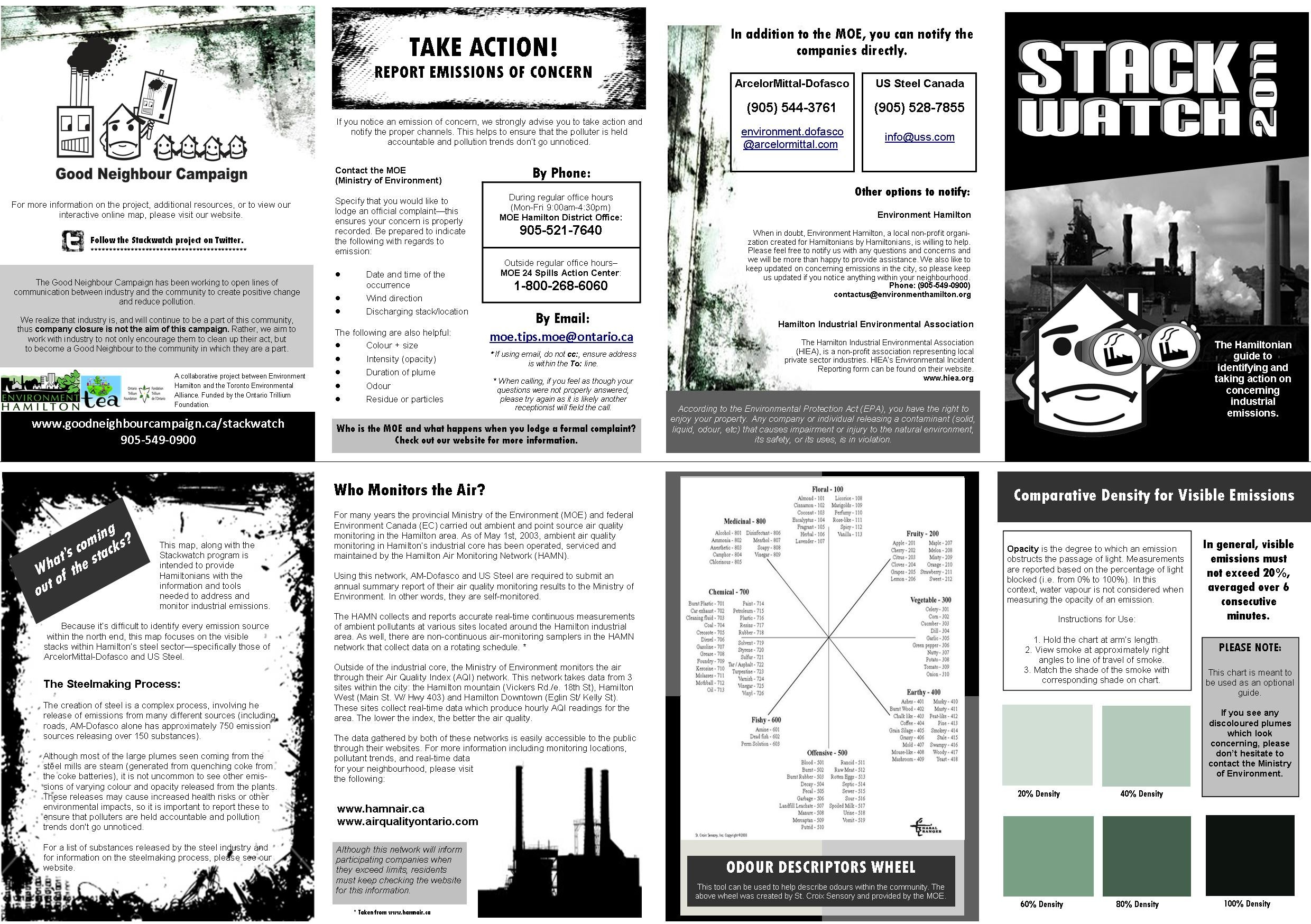
We have also created a more detailed document that provides important information about stack watching and includes various views of the industrial skyline with all active industrial stacks labelled.


The Ministry of Environment, Conservation, and Parks has also set up an online pollution and spills reporting tool at the following link: https://report-pollution.ene.gov.on.ca/
Important pieces of information to include in your report are:
- The date and time of the incident
- The location of the incident (more specific is better)
- The type of weather conditions
- How you were affected by the incident
- A description of what you are reporting and accompanying photos
- E.g. discoloured smoke plumes (such as very dark plumes or colours aside from white and dark grey)
- E.g. larger than usual smokestack plumes
- E.g. soot prevalence at your home or in your community
- Associate smells (see the odour wheel below)
Odour Impacts
Odour is another impact that is related to air quality, but sometimes requires different strategies to resolve. These are helpful resources to help community members tackle odour problems in their neighbourhoods.
This odour wheel, developed by St. Croix Sensory and modified by us for easier public use, is designed to help you to describe the odours you might be experiencing in your neighbourhood:
Historical updates and working groups
CLICK HERE to read the Ontario Environmental Review Tribunal's written decision regarding the Feb/Mar 2019 ArcelorMittal Dofasco blast furnace pollution releases.
CLICK HERE to view Environment Hamilton's submission on ArcelorMittal Dofasco's request for more time to rehabilitate its coke plants.
Ontario Ministry of Environment, Conservation & Parks External Working Group - Reg 419 Local Air Quality - Former executive director Lynda Lukasik served as the Co-Chair of this provincial working group (now discontinued).