
What's The Grime? August 2026 Update
Hi everyone!
It has been 8 months since we picked up the last sample from the What’s the Grime? study in lower city Hamilton.
To recap, our study measures the urban grime in the city—the black soot-y film you’ve been finding on outdoor surfaces. In the grime specifically, we are focusing on three different pollutant groups:
-
Dustfall (‘black soot’ particles)
-
Polycyclic aromatic hydrocarbons (PAHs)
-
Heavy metals
Dustfall. We’ve finished imaging and processing all of the dustfall samples. We generally found darker colour and greater amounts of dustfall near the industrial core in the lower city. We are currently developing a machine program for characterizing the collected grime by its particle size and colour.
As a sample of what we found, here are microscope images taken from Sarah’s (Dr. Styler’s) home in Ward 4:
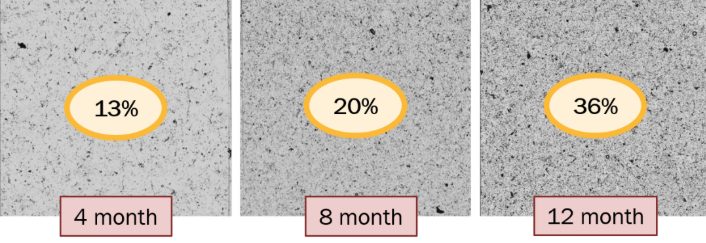
These images show the accumulation of ‘black soot’ over 4, 8 and 12 months. The percentages represent the % of the sample that was covered by black particles.
PAHs. We’ve also finished measuring the toxic PAHs in the grime. We generally found high levels of PAHs, that are higher in the winter than in the summer. The highest levels are found near the industrial core.
The amazing thing about community participation and interest in our study is that we can see how different areas of the city compare to each other. We will report the exact numbers in the future. In our study, we measured PAHs that collect on horizontal surfaces, so our values will not be the same as the ones used for air quality regulations. However, we expect our study’s findings to be important for estimating exposure through contact with contaminated surfaces.
It is important to note that these findings are not yet peer-reviewed by the academic community, which we would like to do before we share more details of our findings publicly. We have just submitted a manuscript for peer review. 😊 We look forward to sharing our findings in more detail soon.
Metals. We have secured some funding to travel to New Brunswick to conduct heavy metal analysis on the 250+ samples collected during What’s the Grime. Thank you to the McMaster University 2025-26 SGS Grant in Aid for Research Travel and Field Work!
Other work. We’ve been working on a lot of behind-the-scenes things, too! Sarah has been working on obtaining funding for an expanded study, What’s the Grime 2, which will include analysis of more pollutants, addressing research questions that have arisen in our conversations with you, and more community outreach and science communication activities. Sarah has also been in the news lately: in a July CHCH podcast focused on wildfire smoke, she also had the chance to talk about the What’s the Grime? project.
Lastly, we would like to thank everyone reading this update for their patience as we work through processing and understanding all the data that this study generated. We will be hosting a progress update webinar for the What’s the Grime? volunteers later in August.
We continue to learn, not only about the grime, but about the best ways to connect with and serve our community. If you have any questions, feedback, or suggestions you would like to share, please reach out to us through our email at [email protected].
All the best,
The What’s the Grime? team
Showing 1 reaction